
HERstory Makers: Susanna Wesley
WRITTEN BY: Sarah Hewitson

John Wesley and his brother Charles did not set out to found a new church.
In the 1720s at the University of Oxford, they gathered a small group of students committed to disciplined prayer, Bible study, fasting, and service to the poor. Their structured spiritual practices led others to nickname them "Methodists." What began as a renewal movement within the Church of England soon spread widely through John's tireless open-air preaching and Charles's hymns, igniting a revival among ordinary people across Britain.
Over time, this movement grew into the Methodist Church, rooted in the conviction that God's grace is available to all and that faith must transform both personal lives and society. But where did the foundation of their faith come from? What example shaped their staunch faith, deep theology, and understanding of spiritual discipline and grace.
The answer is Susanna Wesley, their mother.
Her STORY
Susanna was born the 25th child of a London minister and married an aspiring minister at age 19. She and her husband Samuel Wesley did not have an easy life in the 1600s and 1700s. She lost 9 of her 19 children as infants. Her house burned down twice. Her husband left her for over a year after an argument and was arrested twice for poor handling of finances. She was the primary caregiver for her 10 surviving children, responsible for their spiritual development and education.
So how did this woman, who seemingly had the world set against her, manage to educate and pastor her children and her community? How did she, through these trials, produce children who would go on to shape the modern church?
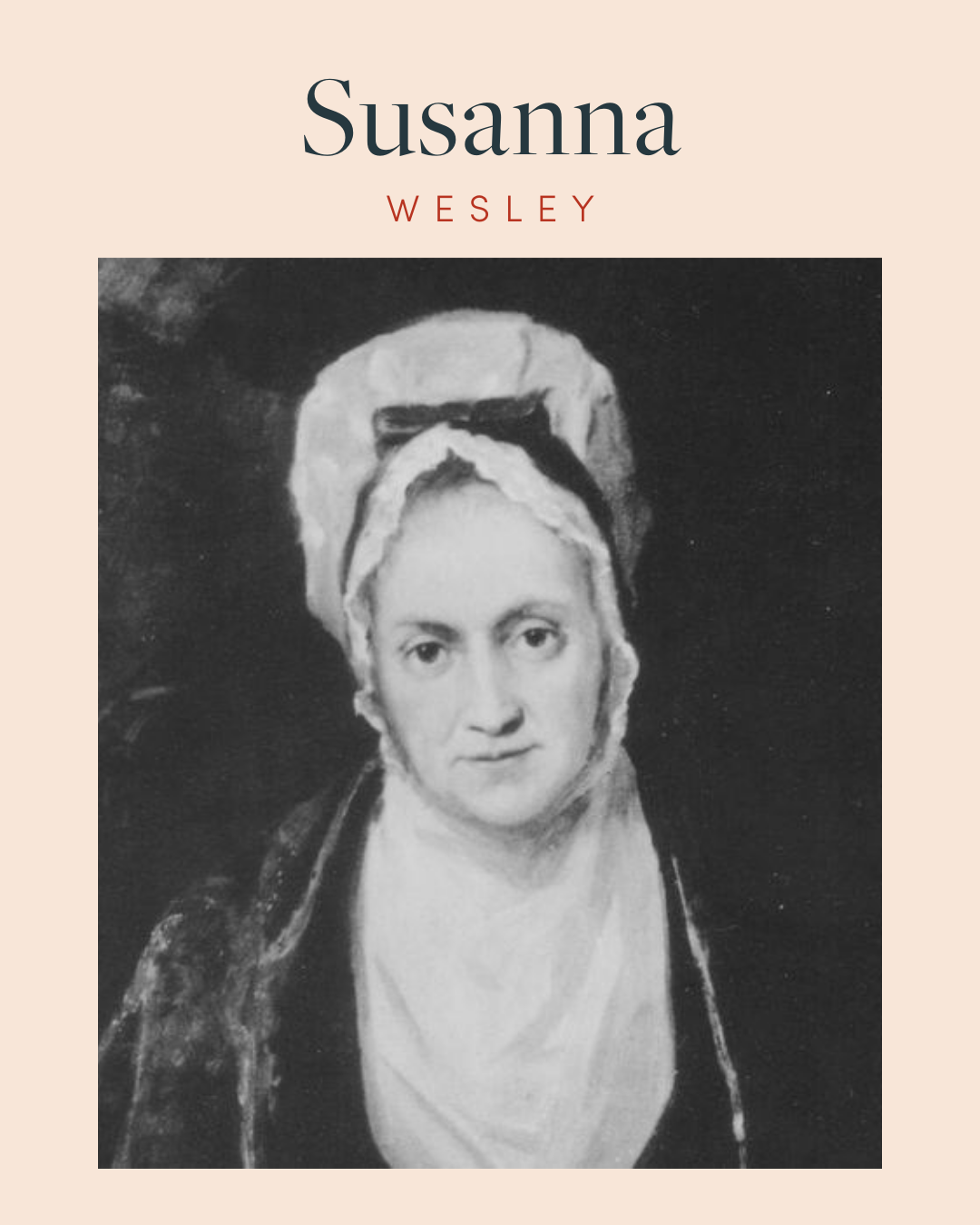
When I think of Susanna, two words come to mind. The first is perseverance, as found in Hebrews 12:1-3 (NIV).
“…And let us run with perseverance the race marked out for us, fixing our eyes on Jesus, the pioneer and perfecter of faith. For the joy set before him he endured the cross, scorning its shame, and sat down at the right hand of the throne of God. Consider him who endured such opposition from sinners, so that you will not grow weary and lose heart.”
In a letter to her son John in her old age, Susanna reluctantly recorded her approach to educating her children. She was hesitant because she assumed such information would not be relevant to her son's growing ministry. But after some prodding, she explained the following:
Her education program was structured and routine, teaching the children discipline and the importance of prioritizing their learning.
Literacy was foundational—Susanna wanted her children to engage with Scripture independently. She also recognized that the ability to read would position her children for success regardless of their path in life, whether ministry, farming, marriage, or otherwise, because of the independence it provided.
She educated her daughters equally to her sons, prioritizing their ability to read over their ability to sew, which at the time was quite a departure from societal norms.
Education was part of spiritual formation. Susanna is quoted as saying "The main end of studying is to know God and to love Him."
She dedicated her life to ensuring that her children had everything they needed to grow in their relationship with God and to succeed in whatever they chose to do. We see the evidence of this in her sons' ministry and music.
The second word that comes to mind when I think of Susanna is boldness. As Paul writes in Acts 4:29 (NIV), "Now, Lord, consider their threats and enable your servants to speak your word with great boldness."
There's another incredible story about Susanna that emphasizes the boldness of her faith. While her husband was in London defending a friend against charges of heresy, he appointed a substitute to preach. The man's sermons revolved solely around repaying debts. The lack of diverse spiritual teaching led Susanna to assemble her children each Sunday afternoon for family services. They would sing a psalm, then Susanna would read a sermon from either her husband's or father's collection, followed by another psalm.
Local people began asking if they could attend. At one point, over 200 people attended Susanna's Sunday afternoon service, while the Sunday morning service dwindled to nearly nothing.
Susanna did not let her gender or the role society tried to limit her to—that of simply being a mother—stop her from teaching her children and community about the word of God and His love. Rather, she embraced who God had called her to be. She made the most of her responsibility for the children she had been blessed with and equipped them to carry out the will of God in their own lives.
This tenacity, boldness, and perseverance is why she is known, quite appropriately, as the Mother of Methodism.
Making HERstory
Susanna's legacy of faith, discipline, and compassion remains steadfast through the church her sons formed. Without her, her sons would not only have perished (in John's case, quite literally, as he nearly died in one of the fires) but would not have been prepared to lead their own ministries.
And yet Susanna Wesley herself never preached in the fields, never wrote thousands of hymns, and never organized a movement that would spread across Britain and the world. Her ministry was quieter, but no less powerful. It took place in a rectory kitchen, around a table with children learning their letters, in long hours of prayer, discipline, and faithful teaching.
Susanna reminds us that the foundations of great movements are often laid in hidden places.
Before there was open-air preaching to thousands, there was a mother teaching her children to read Scripture. Before there were hymns sung across the world, there was a woman insisting that faith required discipline, study, and devotion. Before the Methodist revival spread across Britain, there was a home where perseverance, boldness, and love for God were woven into daily life,
Susanna Wesley's life is a powerful reminder that the work of shaping faith in others—especially in the next generation—is never small. The seeds planted in quiet faithfulness can grow into something far greater than we can imagine.
The Methodist revival that transformed Britain did not begin in a pulpit or a field.
It began in the faith of a mother.

About The Author:
Sarah Hewitson is a UK-based communicator with a Master’s in Theology who speaks with warmth, clarity, and biblical depth. Passionate about the Old Testament and the whole of Scripture, she helps others grow in spiritual disciplines and faith-filled living.
With over 15 years in church ministry—leading volunteer teams, coaching young leaders, and managing events and projects—Sarah is passionate about organizational planning and strategic focus in ministry and leadership.