
WRITTEN BY: Hannah Rowen Fry
Her STORY
She gave it all up.
Her wealth, status, and comfort. Given up to pursue a life of transformation and simplicity in a time where faith and empire became intertwined.
Born of a wealthy sailor, Amma Syncletica declined many marriage offers, cut off all her hair, and renounced a traditional life that would have been socially acceptable for a woman at the time. After the death of her parents, she became the sole caretaker for her blind sister and inherited her family’s fortune. But soon thereafter, she gave her inheritance to the poor and withdrew, as many of the desert fathers and mothers did.
However, instead of heading to the literal desert or a monastery like her contemporaries, she found her dwelling in a small cell alongside her sister–a cell that was intended to be a tomb. This began a life of teaching about virtue and discipline; of submitting herself to identify with the sufferings of Jesus.
She said, “For those who are capable of it, [poverty] is a perfect good. Those who can sustain it receive suffering in the body but rest in the soul, for just as one washes coarse clothes by trampling them underfoot and turning them about in all directions, even so the strong soul becomes much more stable thanks to voluntary poverty.”
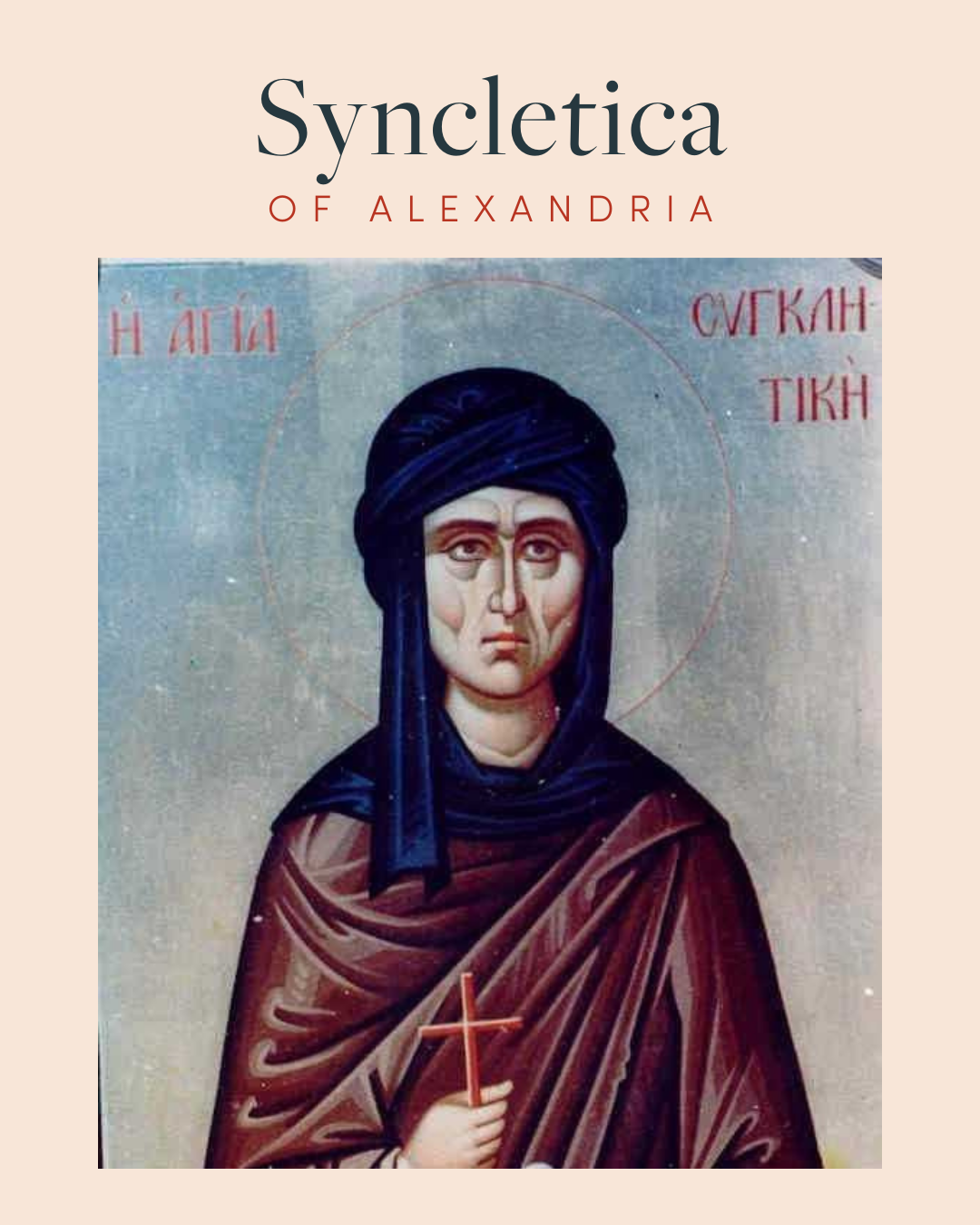
Although she didn’t follow the traditional path of a woman at the time, femininity was vital to her teachings about spiritual life. She used common examples of household chores as metaphors for faith, making an undeniable connection between the female experience and the spiritual life.
The ascetic life she hoped to live in humility was applauded. Women of all ages came to learn from her, following both her teachings and her example. Despite her fame, humility is one of the virtues she is most known for teaching about today. Syncletica has many sayings about humility, like “Just as a treasure that is exposed loses its value, so a virtue which is known vanishes; just as wax melts when it is near fire, so the soul is destroyed by praise and loses all the results of its labour.”
Syncletica’s faith was marked by endurance and inner transformation. Her focus was not on running from challenges, or resisting the ways God might use them, but embracing the suffering of daily life, both big and small. For her, spiritual maturity was not to be rushed. It’s a process of growth throughout a person’s entire life.
This proved to be true even in the final years of her life, as she succumbed to a three-year long illness, writing about chronic pain near the end of her life. “In the same way that a powerful medicine cures an illness, so illness itself is a medicine to cure passion. And there is much profit of soul in bearing illness quietly and giving thanks to God.”
Making HERstory
Drawing from her experiences as a sailing merchant with her father, and the never-ending task of domestic labor with her mother, her teachings tend to be easy to connect with even still today, rooted in nature or everyday life.
Fourth century Alexandria was known as a hub for theological questioning, philosophical conversations, and challenging authority. Syncletica–along with other desert mothers and fathers–sought a different way of life by withdrawing from the continuing conflicts around church and politics. They resisted empire; the Jesus they knew was a man of meekness, not of power.
We’re living in a time where faith and empire have again become intertwined. Syncletica’s choices and teachings are needed now just as much as they were in her time.
In a time where pastors become celebrities, and celebrities become pastors, I remember her simple charge: “For just as it is impossible for a ship to be built without nails, so it is impossible to be saved without humility. Let humility become for you the beginning and end of virtues.”
With rising political tensions and war, I remember Syncletica’s wisdom to “choose the meekness of Moses and you will find your heart which is a rock changed into a spring of water.”
With a news cycle marked by fear and anxiety, I remember her caution that “we must watch for the attacks of men that come from outside us, and also repel the interior onslaughts of our thoughts.”
In a time when systemic oppression is seemingly unending, I remember the truth that the darkness we face is not new or unique. Syncletica’s words give me steadfast hope when it’s hard to see progress, “We sail on in darkness… We always set our course by the sun of justice.”
Although most of us will not enter into a life of voluntary poverty and move into an empty tomb, may we still learn from this HERstory Maker, Amma Syncletica of Alexandria. Just as she gave up her wealth, status, and comfort for the sake of inner transformation, we, too, must release what threatens to hinder our becoming more like Jesus. Instead of withdrawing to the desert–an external change–Syncletica focused on an internal transformation, on the cleanliness of her soul.
She said, “In the beginning there is struggle and a lot of work for those who come near to God. But after that there is indescribable joy. It is just like building a fire: at first it is smoky and your eyes water, but later you get the desired result. Thus we must kindle the divine fire within ourselves with tears and effort.”
May we spend our days fasting and praying like Syncletica, trusting God, and tending to the fire of our souls.

About the Author:
Hannah Rowen Fry is a writer and speaker passionate about helping people live into their God-purpose. Her thoughtful reflections on Scripture invite those who feel overwhelmed to slow down, choose simplicity, and experience greater joy in the present moment. Read more about Hannah and her work at www.hannahrowenfry.com.