
Written By: Caiti Spiess

Whimsy is having a moment right now.
Bright and colorful wardrobes. Dopamine home decorating. People planting wildflowers where perfect landscaping used to be. I think there's a reason for it–I think we're hungry for play.
Hungry for delight, for surprise. Hungry for permission to enjoy things that don't earn us anything. I think deep down, many of us miss the summers of collecting rocks because they looked interesting, lying in the grass watching clouds, or laughing so hard our stomachs hurt.
As we grow up and move from childhood into adolescence, instead of being taught how to continue playing into adulthood, it often seems to be taught out of us. And I can’t help but notice for those of us in the church, play often seems like the last thing on our minds. We talk about Bible reading plans, different ways we can serve, how to use our spiritual gifts, and all the ways we can grow in our faith. Please hear me, I believe all those things matter.

However, I wonder if maybe in our efforts to take our faith in Jesus seriously, we've simply gotten too serious.
I know I'm guilty of this.
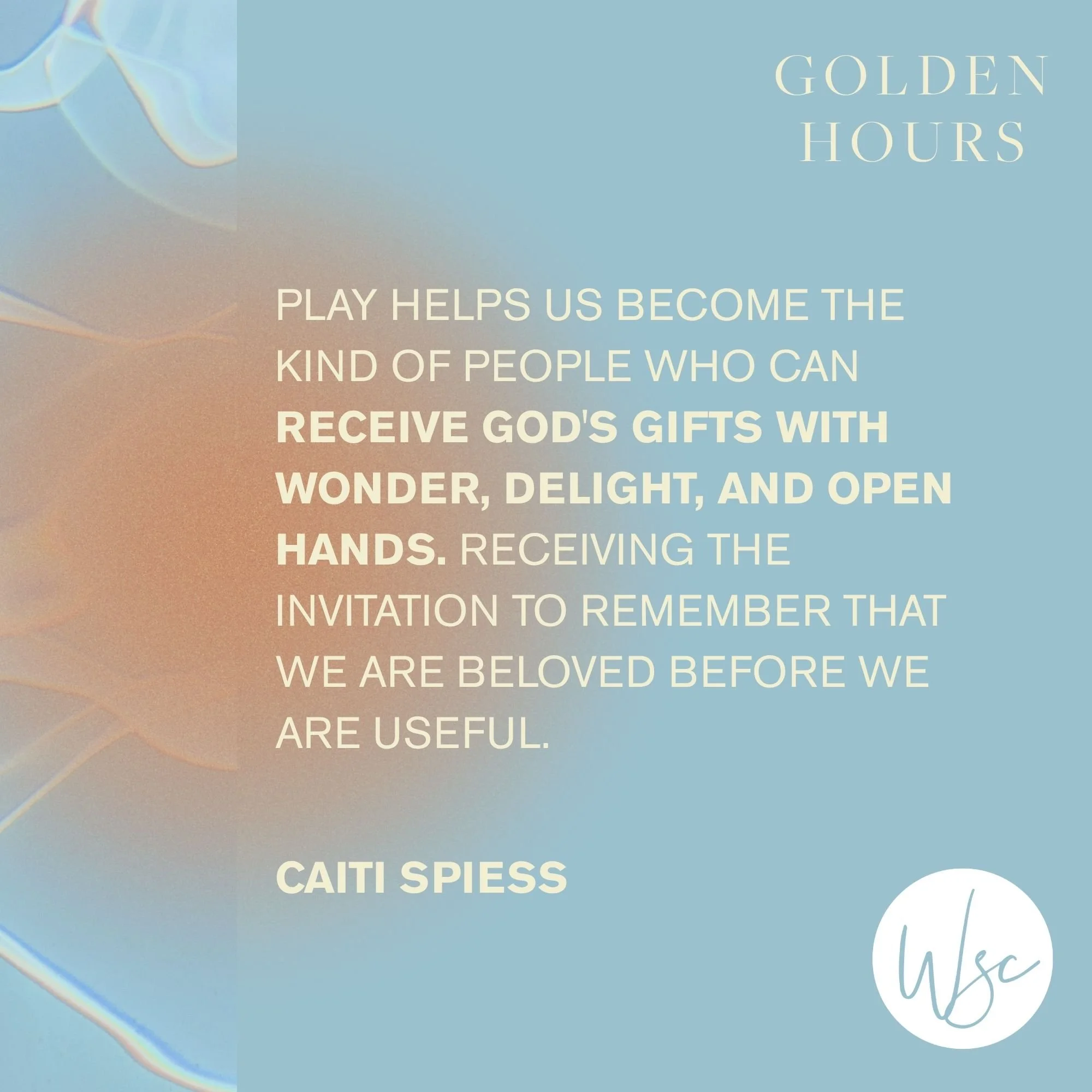
But play may have a significant role to play (pun intended) in our spiritual lives. Not because it's another box to check or habit to master, but because it helps us become the kind of people who can receive God's gifts with wonder, delight, and open hands. Receiving the invitation to remember that we are beloved before we are useful.
Believe it or not, play has been a topic of research for decades. Researchers define play as voluntary, enjoyable, and done for its own sake. Children don't need the definition. They simply know. They build forts from couch cushions, invent games with arbitrary rules, and turn cardboard boxes into trash monsters. They awake each day full of wonder. They notice things. They imagine. They create. They delight in small things.
I think many of us miss that curiosity, freedom, and joy we once knew.
Perhaps it shouldn’t be a surprise that Jesus told us in Matthew 18:3 “Truly I tell you, unless you change and become like little children, you will never enter the kingdom of heaven.” (NIV)
The God who made us seems to delight in creativity, beauty, and surprise, too! The Creator of the universe could have made everything practical and predictable. Instead, He painted sunsets no one would photograph. He created hummingbirds that can fly backward and the platypus, who still feels like a joke someone forgot to explain. He filled seashells with intricate spirals. He created the aurora borealis dancing across the night sky. He gave us laughter, imagination, music, storytelling, and the ability to be moved by beauty.

Scripture tells us that "from Him and through Him and to Him are all things" (Romans 11:36 NIV). If all things ultimately find their source in God, then perhaps our capacity for wonder, creativity, delight, and playfulness reflects something of His nature, too. Play may not simply be a childhood pastime. It may be one of the ways we participate in the goodness and beauty of God's creation.
We often limit childlike faith to be just about trust, but play shows us it’s deeper than that. It is wonder.
Children naturally receive the world as a gift. They aren't trying to optimize every moment or prove their worth. They simply delight in what is right in front of them.
For me, those words from Jesus frequently get drowned out by the roar of adult responsibilities. There are meals to cook, bills to pay, emails to answer, and endless items competing for my attention. Play can feel like a luxury. A distraction from more important work.
But what if play isn't a distraction from our spiritual lives? What if it's one of the ways God invites us back into them?

It is contentment–a byproduct of childlike faith I didn’t expect! It is presence.
When I'm doodling and coloring during a meeting, creating inside jokes with my kids, or watching a comedy show with my husband, I'm not accomplishing anything measurable. Nothing is being optimized. No goal is being checked off.
Yet those moments remind me that life is more than productivity. Play asks nothing from me except presence. It teaches me to enjoy what already is instead of constantly chasing what comes next. In a culture obsessed with more, play has been quietly teaching me how to delight in enough.
It is simplicity. It is joy.
A coloring page. A walk outside. A board game. Dancing in the kitchen. Planting flowers. Watching birds bop around.
Not because those things accomplish something extraordinary, but because they invite us to be fully present to the extraordinarily simple gifts already surrounding us.

Play feels risky because it doesn't need to be productive, optimized, or measured. It doesn't produce a report, earn a promotion, or move us closer to a goal. It simply invites us to enjoy what is right in front of us. And that may be exactly why it matters.
Maybe you don't need convincing that play is valuable. Maybe for you the question is how to rediscover it after years of responsibilities, deadlines, and expectations.
Cas Holman, business owner, professor, and author of Playful, suggests that playfulness isn't necessarily about adding something new to your life. She says, “The way you take your kids to school can be playful. The way you fold laundry can be playful. The way you conduct a meeting can be playful. It's not about doing more. It's about doing things differently.”
Believe me, I can be the person who makes this far more complicated than it needs to be. So lately I've been looking for small opportunities to play. I've been knitting again when I feel like it, I've been spontaneously being silly. I’ve been gamifying household chores.
None of those things are impressive. But all of them help bring me home to myself and what God is doing right in front of me.
Play can begin smaller than we think. Maybe it looks like taking the long way through the park. Doodling in the margins of your notebook. Planting flowers simply because they're beautiful. Dancing while dinner cooks. Laughing at a joke that isn't particularly clever.
None of those things will change the world. But they might change us. They remind us that life is not merely something to manage. It is also something to receive… and enjoy.
And perhaps that is part of what Jesus meant when He called us toward childlike faith; not a faith that is childish, but a faith that still knows how to wonder. A faith that delights in small gifts.
A faith that still knows how to play.